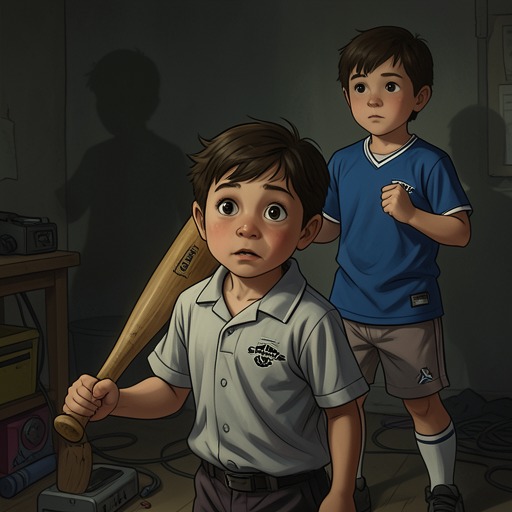
Your fear is your strength
Kevin the Star Striker“Your fear is your strength” is the defining expression of Larry’s coaching philosophy in The Wild Soccer Bunch. It transforms fear from a shameful weakness into a source of awareness, discipline, and possible victory. The idea matters because the Wild Soccer Bunch face opponents who are physically larger, openly violent, and confident that intimidation has already decided the match; Larry’s method begins by making the players admit what they feel rather than pretending to be invulnerable.
The Expression and Its Immediate Meaning
Larry introduces the principle when Diego asks what the team is supposed to do with its fear. The question follows Kevin’s reluctant admission that he is “scared stiff,” and Larry answers that their fear is “fantastic” because it gives them a chance. His formulation does not praise panic for its own sake. It identifies fear as evidence that the players understand the danger and therefore have something real to respond to.
The expression is inseparable from Larry’s demand for honesty and mutual trust. He tells the team that a coach cannot be trusted unless the players trust him completely, and that he must trust them in return. Fear becomes useful only after it is acknowledged within that relationship. The principle therefore joins emotional honesty to collective action: the players do not overcome fear by denying it individually, but by making it speakable and then relying on one another.
Fear as a Training Tool
Larry turns the expression into a physical method during the team’s muddy training. Without a soccer ball, the players run in pairs across ground filled with stones and holes, imagining that the obstacles are the legs of the Unbeatables and that they must dodge, leap, and move between them when opponents foul or charge at them. When Danny complains that the mud is as slippery as an ice rink, Larry agrees and gives the mud a precise symbolic function: it represents the fear and unsteady knees produced by players such as Mow-down, Juggernaut Jim, and Kong running toward them.
This exercise makes fear concrete rather than abstract. The players cannot remove the mud, just as they cannot make the Unbeatables smaller or gentler. They can learn to move within the threatening conditions. Larry’s coaching thus treats fear as information about the environment: it reveals where balance may fail, where hesitation may begin, and what kind of preparation the body needs.
Contrast with the Unbeatables
The principle gains its full force against the Unbeatables’ language of absolute domination. Mickey the Bulldozer declares that the soccer field belongs exclusively to the Unbeatables and orders the Wild Soccer Bunch to leave. Kevin answers with a two-week challenge, offering the field permanently to the winner. The challenge is spoken in the language of bravado, but its underlying condition is more serious: the Wild Soccer Bunch must face a team that has already converted size, violence, and public humiliation into instruments of control.
Mickey’s persona depends on appearing fearless. He is described as the “Darth Vader” of the boys’ world, surrounded by followers and confident that intimidation will silence resistance. His later accusation that Larry was never a professional player is another attempt to destroy authority through humiliation. In this environment, admitting fear can look like surrender, while loud threats appear to constitute strength. Larry’s expression reverses that hierarchy. It suggests that the Unbeatables’ performance of fearlessness may leave them less prepared for uncertainty, whereas the smaller team’s acknowledged fear can sharpen its attention and preserve its capacity to adapt.
The Principle Tested in the Match
The match initially appears to disprove Larry. After seven minutes, Mickey has scored five goals himself, while the Wild Soccer Bunch lie on the grass battered and demoralized. Julian has a severely discolored black eye, Tyler holds his ribcage, and Kevin has scraped his knee. Kyle’s careful joke that the game is “Not quite going the way we planned, is it?” is answered only by the Unbeatables’ laughter, and Joey responds with a promise that they will see who has the last laugh.
The most direct test comes when the pressure causes Julian to retreat from the fearless player Larry knows. After Octopus sends the ball across the field, Julian faces Mickey with Alex Alexander, but he is “scared stiff” and does not attack. Mickey scores again. The scene gives Larry’s teaching a painful precision: fear has not magically made Julian brave, and it cannot prevent injury or defeat. The expression is not a guarantee of immediate success. It describes a potential strength that must be developed through trust, practice, and coordinated play.
Narrative and Thematic Significance
“Your fear is your strength” counters the book’s repeated insistence that the Wild Soccer Bunch are “dangerous” and “wild.” Their identity is not finally secured by pretending to be eleven invulnerable friends with a cute dog. It is tested when the team’s self-image collides with the Unbeatables’ physical superiority and with the truth about Larry’s past. The expression offers a more demanding version of wildness: courage begins with recognizing danger, not with claiming that danger does not exist.
The idea also distinguishes team strength from solitary aggression. Kevin’s challenge to Mickey is audacious, but the match shows the limits of individual defiance when the players stop trusting one another. Larry’s lesson points toward a different form of sporting masculinity, one in which honesty, shared responsibility, and the ability to keep functioning under fear matter more than the performance of invulnerability. The phrase therefore serves both as coaching advice and as a thematic key to the Wild Soccer Bunch’s struggle for the soccer field: fear can become strength only when it is admitted, interpreted, and turned into collective movement.